
Moving to Kailua, HI: Essential Tips for 2026
Moving to Kailua HI in 2026 means adapting to a coastal town where lifestyle costs, climate, and logistics differ from many mainland markets. According to U.S. Census QuickFacts, Kailua’s population hovered in the high 30,000s in 2020, supporting a robust yet small-town scale of services. Long-time residents balance beach-focused routines at Kailua Beach Park and Lanikai Beach with commutes into Honolulu. Understanding housing, schools, transportation, and daily services in detail helps future residents enter this market with realistic expectations.
What lifestyle changes come with moving to Kailua HI in 2026?
Relocating to Kailua reshapes daily rhythm around the ocean, trade winds, and outdoor recreation. Kailua Beach Park, Kalama Beach Park, Kawainui Marsh, and Maunawili Falls Trail sit within a few miles of most homes, making pre-work paddles or sunset walks common. According to the City and County of Honolulu Department of Parks and Recreation, Kailua Beach Park spans roughly 35 acres, providing extensive shoreline access and picnic areas that shape weekend routines for many households.
On an early trade-wind morning along Kailua Road near Kalapawai Market, the air carries the smell of fresh coffee and baked pastries, mixed with the salty tang drifting from Kailua Bay. Soft light hits the turquoise water beyond Kailua Beach Park, while the rustle of ironwood trees blends with conversation outside Island Snow and the low hum of traffic on Kalanianaole Highway. That sensory mix of ocean, food, and quiet street noise defines everyday living more strongly than any statistic.
Island-style schedules often start earlier, partly due to daylight and partly to beat traffic toward Honolulu via Pali Highway and H-1. According to the Hawaii State Department of Transportation’s corridor summaries cited by TheBus planning resources, rush-hour trips between Kailua and downtown Honolulu can range from 30 to 50 minutes depending on congestion and weather. Residents who time grocery runs at Whole Foods Market Kailua or Target Kailua around those peaks usually find far shorter lines and easier parking.
Climate shapes both comfort and budgets. Trade winds moderate high temperatures, yet humidity and salt air affect maintenance schedules. Based on long-term station data compiled by the National Weather Service Honolulu Office, windward Oahu communities like Kailua typically receive between 40 and 60 inches of annual rainfall. That pattern keeps Hāmākua Drive greenery lush but also increases the importance of regular roof inspections, mold prevention, and careful storage for sensitive belongings during the rainy season.
How do housing options and costs look for moving to Kailua HI?
Housing choices in Kailua range from condominiums near Oneawa Street to single-family homes along Lanikai Beach and Enchanted Lake. According to Redfin, listings in Kailua consistently rank among the more expensive areas on Oahu, with many single-family homes offered above $1,300,000 as of late 2024. That figure reflects location scarcity, strong second-home demand, and limited new construction capacity between the Koolau mountains and the shoreline.
Condominiums along Hamakua Drive and near Kailua Town Center provide relatively more attainable entry points. Based on current listing data summarized by Realtor.com, many Kailua condos fall in a broad range from roughly $600,000 to just under $1,000,000, depending on age, size, and proximity to Kailua Beach. Those figures fluctuate each quarter, yet they highlight the gap between condo and detached home price levels within the same small geographic area.
Property taxes remain a smaller portion of monthly cost than principal, interest, and insurance, yet they still matter. According to the City and County of Honolulu, effective residential tax rates generally fall in the range of 0.35% to 0.45% of assessed value, with higher tiers for certain investment classifications. In a town where many homes exceed $1,000,000 in assessed value, careful attention to classification, exemptions, and long-term planning can avoid surprises.
Renovation and long-term upkeep costs trend higher than many mainland buyers expect. Shipping, specialized trades, and hurricane-rated materials lead to project budgets that can easily surpass $250 per square foot. Contractor surveys cited by HiCentral MLS market commentary note that substantial remodels on Oahu often land in the $300 to $500 per-square-foot range, and ambitious custom builds in beach-adjacent pockets like Lanikai sometimes reach or exceed $2.4M in total construction spending.
What schools and family resources stand out when moving to Kailua HI?
Kailua’s school network shapes neighborhood choice for many households. Public options include Kailua Elementary School, Lanikai Elementary Public Charter School, Kaelepulu Elementary, Aikahi Elementary, Kailua Intermediate School, and Kalaheo High School. According to GreatSchools, Kailua Intermediate holds a mid-range rating, while several nearby elementaries score between 7 and 9 out of 10 in specific academic and equity categories, though ratings change as new data appears.
Afternoons around Kailua District Park and the fields behind Kalaheo High School carry the sound of whistles, soccer balls striking goalposts, and kids laughing while running drills under the warm sun. The smell of plate lunches from nearby eateries on Hahani Street drifts across the grass, and parents lean against cool aluminum bleachers watching games. Palm fronds sway above the track as clouds build over the Koolau Range, creating a vivid green backdrop that often convinces newcomers that the neighborhood already feels like home.
Private and charter alternatives create additional choice. Lanikai Elementary Public Charter School near Aalapapa Drive attracts interest for its project-based learning approach and beach-adjacent campus. According to enrollment snapshots cited by GreatSchools, student body size has hovered around the mid-300s in recent years, which supports smaller class sizes than many large mainland districts. Windward Nazarene Academy and Trinity Christian School add faith-based options within several miles of most Kailua addresses.
Family resources extend beyond classrooms. Enchanted Lake Community Park, Kailua Public Library on Kuulei Road, and Aikahi Park Shopping Center host events and after-school meetups. The TheBus system provides youth-friendly routes connecting Kailua to Kaneohe and Honolulu, with travel times often between 45 and 60 minutes depending on transfers. That connectivity broadens access to programs at institutions like the Bishop Museum and Honolulu Museum of Art without requiring every teen to have a car.
How do commute, transit, and everyday logistics function in Kailua HI?
Relative isolation between the mountains and coastline gives Kailua a small-town feel while still linking to urban employment centers. Commutes to downtown Honolulu typically use Pali Highway or Likelike Highway. According to regional traffic studies summarized by TheBus, peak-hour vehicle travel between Kailua and the central business district often ranges from 30 to 45 minutes. Off-peak drives can drop closer to 20 minutes when weather and incidents cooperate.
Walkability within Kailua Town reduces daily car dependence for many residents. The core around Kailua Road, Hahani Street, and Kuulei Road holds Target Kailua, Whole Foods Market Kailua, Foodland Farms, Longs Drugs, Morning Brew, and several banks within short walking distance of nearby condos. According to Walk Score, Kailua’s overall walk score falls in the mid-60s, with certain central blocks reaching the high-70s, indicating that many errands can be completed on foot or by bike.
Bikeability and beach access also influence daily routines. The flat stretch along South Kalaheo Avenue toward Lanikai Beach sees steady bicycle and pedestrian traffic, especially around sunrise and late afternoon. Based on field observations cited in Honolulu’s Bicycle Program materials, key corridors near Kainalu Drive support both casual riders and more serious cyclists completing 10- to 20-mile loops that include Kailua, Waimanalo, and back through Pali Highway. That pattern reduces some local car trips while increasing attention to bike storage in smaller condo units.
Grocery, healthcare, and essential services remain concentrated but accessible. Adventist Health Castle (formerly Castle Medical Center) sits just mauka of Kalanianaole Highway, within roughly 2 to 3 miles of most Kailua neighborhoods, according to distance estimates compiled in Adventist Health Castle patient materials. Pharmacies, urgent-care clinics, and veterinary offices line major roads such as Hamakua Drive and Oneawa Street, allowing most residents to handle day-to-day needs without leaving the windward side.
What practical planning steps help a 2026 move to Kailua HI succeed?
Careful budgeting and timeline management shape successful relocations into Kailua’s constrained housing market. According to mortgage program summaries from the U.S. Department of Housing and Urban Development, FHA loans allow minimum down payments as low as 3.5% for qualified borrowers nationwide, though many Kailua sellers prefer stronger conventional offers. In a competitive environment where multiple bids remain common, strong prequalification and comfort with appraisal gaps become essential components of a winning strategy.
Shipping household goods across the Pacific requires earlier coordination than many mainland moves. Freight providers serving Honolulu Harbor often advise booking container space at least 6 to 8 weeks ahead during peak summer periods, based on scheduling guidance compiled by Matson. That timeframe helps align delivery with lease start dates in condo communities off Hamakua Drive or move-in dates for single-family homes near Aikahi Park. Delays can otherwise leave households juggling temporary storage and short-term rentals.
Vehicle decisions also matter. According to registration fee tables from the City and County of Honolulu Motor Vehicle Division, annual vehicle registration costs on Oahu scale with weight, often ranging from roughly $300 to $500 per car. Combining that with mainland shipping charges that can exceed $1,500 per vehicle encourages some incoming residents to downsize fleets before relocating, then rely on biking, walking, and TheBus for part of their daily travel.
Establishing routines around local realities eases the first 90 days. Many new residents schedule regular grocery runs to Foodland Farms or Safeway in the late evening, book surfboard or kayak storage near Kailua Beach Adventures before the weekend rush, and learn TheBus routes connecting Kailua to Ala Moana Center. According to ridership reports summarized by TheBus, core routes serving windward Oahu carry thousands of daily passengers, reflecting a transit network robust enough to support intentional car-light lifestyles once habits catch up.
The population in the high 30,000s cited at the start of this guide reflects a community large enough to support diverse amenities yet small enough that supply remains tight. That same figure from the opening underscores how even a few dozen new listings or closed sales can materially shift perceived opportunity in Kailua’s submarkets. The HiCentral MLS monthly data releases provide one of the clearest views of active inventory, price brackets, and days on market across windward Oahu. Buyers who register listing alerts through MLS-connected portals and commit to touring serious options within 48 hours of activation before the late-spring surge in May typically secure stronger positions in negotiations. Households that postpone engagement until after that seasonal upswing often face steeper competition, higher effective prices, and a narrower selection of homes aligning with long-term goals.
FROM OUR BLOG

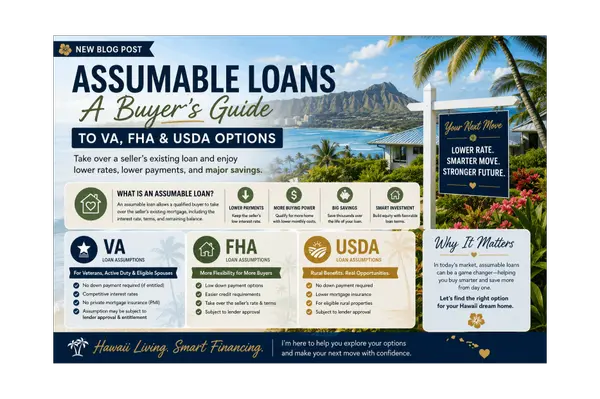
Assumable Loans: A Buyer’s Guide to VA, FHA, and USDA Options
Imagine stepping into a home—and also stepping into the previous owner’s low mortgage rate. That’s the magic of assumable loans, a unique option that can make buying a home more affordable and accessible, especially when interest rates are on the rise. What Is an Assumable Loan? An assumable loan le
Discover the Best Residential Properties in Honolulu, HI: 2026 Market Insights
Discover the Best Residential Properties in Honolulu, HI: 2026 Market Insights Honolulu HI residential properties in 2026 reflect a constrained yet resilient island market shaped by limited land and steady demand. According to Zillow, the typical Honolulu home value stood near $840,000 in early 2026
Ewa Beach Condominiums for Sale: Your 2026 Buyer’s Guide
Ewa Beach Condominiums for Sale: Your 2026 Buyer’s Guide Interest in Ewa Beach condominiums for sale continues to accelerate as infrastructure expands toward Kapolei and the West Side. According to Redfin, as of early 2026 many Ewa Beach condos trade in the approximate range of $550,000 to $650,000,